SQI College Awards ₦1.2m to Outstanding Graduates at Second Convocation
The institution also celebrates academic excellence, announces accreditation milestones and challenges graduates to leverage AI and digital skills to shape the future.
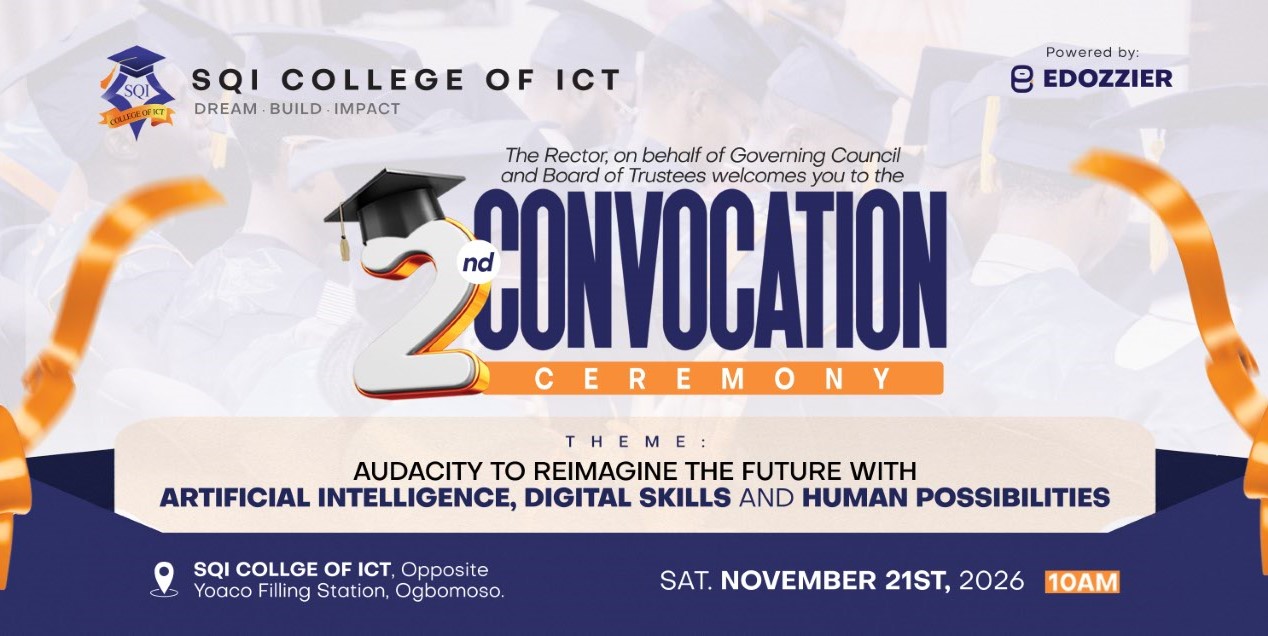
SQI College of ICT, Ogbomoso, Oyo State, has awarded cash prizes totalling ₦1.2 million to outstanding graduates at its Second Convocation Ceremony held on Saturday, November 21, 2026.
The ceremony, which attracted graduating students, parents, guardians, industry leaders, partners and members of the institution’s community, celebrated academic achievements, innovation and the growing impact of technology education.
The event was themed, “Audacity to Reimagine the Future with Artificial Intelligence, Digital Skills and Human Possibilities.”
Speaking at the ceremony, the Rector of the institution, Dr. Adegbenro Sunday Ajani, challenged the graduates to see themselves beyond job seekers and become problem-solvers, innovators and creators of opportunities.
Dr. Ajani said the rapid advancement of Artificial Intelligence and other digital technologies was transforming sectors such as healthcare, education, manufacturing, communication, research and business, creating opportunities for young people to make global contributions irrespective of their geographical location.
He urged the graduates to move beyond merely using AI to generate responses or content and begin leveraging the technology to solve real-world problems, develop products and build sustainable businesses.
According to him, the purpose of technology education should not be limited to preparing graduates for existing employment opportunities but should equip them with the capacity to create solutions and contribute meaningfully to society.
The Rector also encouraged the graduates to embrace continuous learning, practical experimentation, collaboration and personal development, noting that their certificates should mark the beginning of a lifelong journey of innovation.
He appreciated parents and guardians for their sacrifices and support, while calling on industry stakeholders to strengthen partnerships with the institution through internships, mentorship, industrial projects, research, product development and employment opportunities.
₦1.2m shared among eight award categories
A major highlight of the ceremony was the recognition of eight outstanding student achievements across leadership, entrepreneurship, academic performance and practical innovation.
The awards, presented by the institution and its partners, came with cash prizes and letters of commendation.
The recipients included Obiasogu Esther Chizaram, who received the Dr. Peter Bright Award for Leadership and Outstanding Character, alongside ₦100,000.
Esther, a former class representative of the 2024/2025 set, graduated with a CGPA of 3.89 (Distinction). She secured two full scholarships to further her education, one from a Nigerian university and another from an international institution. She also secured full-time remote employment as a software engineer following her industrial training placement.
Jokotoye Testimony Idowu received the Vela Prints Award for the Most Industrious Student, with a cash prize of ₦100,000. He founded Campus Link, a startup that has recorded over 200 student registrations across SQI, LAUTECH, Babcock University and Lead City University. He also secured remote employment with Delvora Space.
Other award recipients were Alagbe Abraham Abiodun, who received the Adeyemi Aderinto Award for Best Student in Computer Science (Java Option), with a CGPA of 3.89 (Distinction); Bamidele Mercy Enoch, recipient of the Professor Adeolu Afolabi Award for Best Student in Computer Science (Cyber Security Option), with a CGPA of 3.81 (Distinction); and Oladipupo Samuel Toluwani, who received the Professor Abimbola Adebisi Baale Award for Best Student in Computer Science (Data Science and Artificial Intelligence Option), with a CGPA of 3.53 (Distinction).
Gbadamosi Ridwan Adekunle received the Engr. Fredrick Aderinto Award for Best Student in Computer Hardware Engineering, having graduated with a CGPA of 3.68, while Adekola Israel Pelumi received the Teslim Salaudeen Award for Best Student in Computer Science (Software Engineering Option), with a CGPA of 3.90 (Distinction).
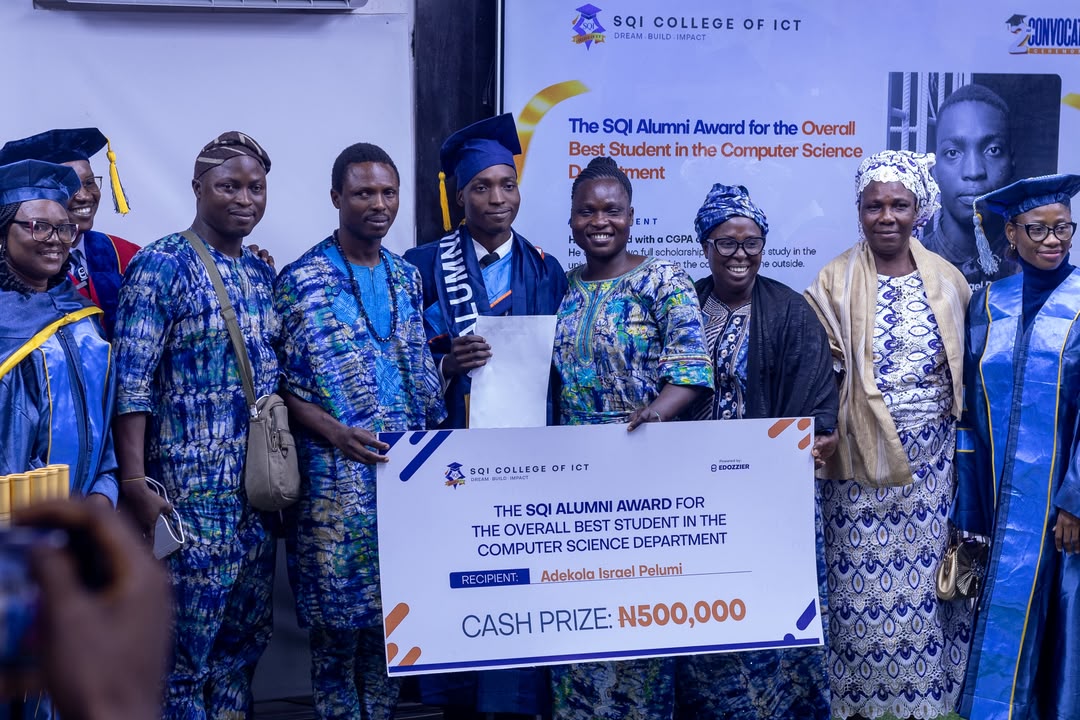
Israel also emerged as the Overall Best Student in Computer Science, receiving the SQI Alumni Award and a cash prize of ₦500,000, in addition to the ₦100,000 award received in the Software Engineering category.
The graduating students distinguished themselves through projects addressing practical challenges, including livestock farm management, cybersecurity and digital forensics, nutritional recommendations, gas leak detection and AI-powered management solutions.
SQI announces accreditation milestones
The Rector also highlighted developments in the institution’s academic and institutional growth, including the completion of its SIWES and TVET accreditation processes and ongoing progress towards HND accreditation.
He said the developments were part of efforts to strengthen the institution’s academic capacity, expand access to quality technical education and ensure that its training programmes remained relevant to industry demands.
The ceremony also featured a keynote address by Mrs. Theresa Ofordu, Co-Founder and Chief Executive Officer of Boost Technology Nigeria.
Her participation underscored the importance of aligning technical education with industry expectations and equipping graduates with the skills required to navigate the changing world of work.
The convocation marked another milestone in SQI College of ICT’s commitment to producing technology professionals equipped with practical, industry-relevant skills.
As the graduates begin their next phase, the institution urged them to apply their knowledge towards building innovative solutions, creating employment opportunities and contributing to the development of their communities.
The Rector’s central message to the graduating class was that Artificial Intelligence expands what machines can do, digital skills expand what individuals can achieve, while imagination expands what societies can become.
He charged the graduates not merely to adapt to the future but to have the audacity to reimagine it.